

Note: I wrote this piece earlier in the year for another publication. It didn’t end up going to print, so I wanted to share it here. It’s about one of the greatest stand-up comedians of all time.
Last fall, the US stand-up comedy community was embroiled in controversy. A veritable who’s who of American comedians, including Bill Burr, Louis CK and Dave Chappelle, were slated to perform in Saudi Arabia at the Riyadh Comedy Festival. While they and many of their peers were seemingly able to reconcile the moral dilemmas inherent in performing at a comedy festival put on by the Saudi government, others had a harder time with it.
“From the folks that brought you 9/11. Two weeks of laughter in the desert, don’t miss it!” joked comedian Marc Maron during a live stand-up set.
“I am disgusted, and deeply disappointed in this whole gross thing,” said Arrested Development’s David Cross in an official statement. “That people I admire, with unarguable talent, would condone this totalitarian fiefdom for…what, a fourth house? A boat? More sneakers?”
Even the Human Rights Watch stepped in, saying “The Saudi government is using the Riyadh Comedy Festival … to deflect attention from its brutal repression of free speech and other pervasive human rights violations.”
These are all valid criticisms. But there’s something else I can’t help thinking about, something apart from each comedian’s personal choice to perform or not perform in Riyadh.
When did the world start taking stand-up comedy so seriously?
Over the last fifteen years or so, it feels like comedy in America has taken on an outsized importance in its relation to political and social issues. This is a fairly new and novel phenomenon. Sure, in the past there were a handful of comedians - most notably Lenny Bruce, George Carlin, and Bill Hicks - who made politics a central pillar of their comedy acts. But the history of the art form is mostly focused on small observations of daily life, the ways men and women differ from each other, and how a third thing is different from two other things. Only recently would a comedian be expected to take a stand on geo-political conflicts, release sincere public statements in the wake of a controversy, or have an opportunity to interview the President of the United States in front of tens of millions of viewers.
What happened that led to this shift? There are a multitude of factors, including the rise of social media and the increased prominence of politics in American life in general, but I think a lot of it can be traced back to one particular comedian. He didn’t intend for this to happen, it was merely the natural outgrowth of his talent and standing within the world of comedy. This comedian was so influential that his untimely death left a gaping hole in the comedy community that comics and comedy fans have been trying - consciously or unconsciously - in vain to fill ever since. Current Year take merchants want to be like him, only they don’t have the talent, intelligence, or courage to pull it off.
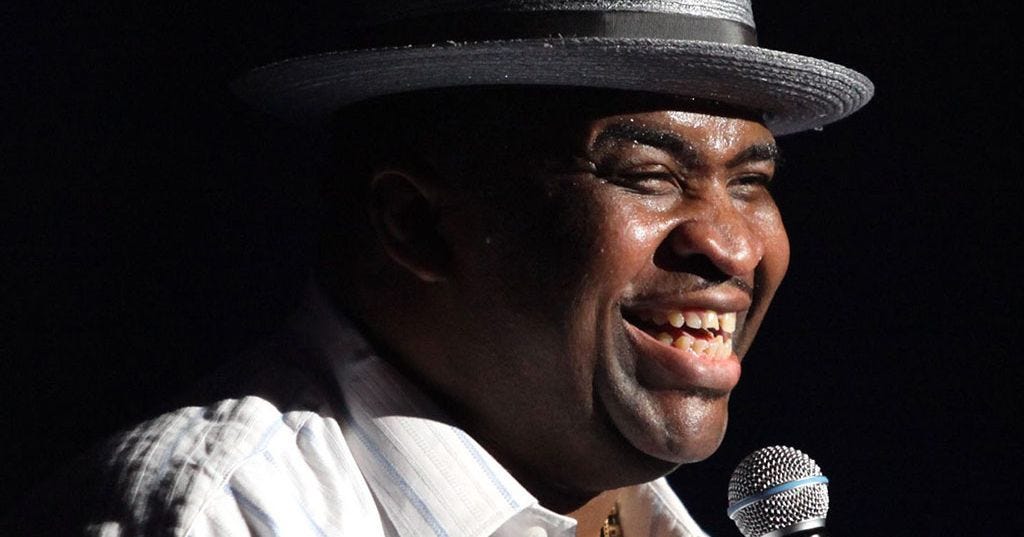
He was brash and outspoken, with a mode of thought that regularly blurred the lines between the comedic and the philosophical. He was a comedian who was so singularly funny and insightful, so far ahead of his peers and society writ large, that many have never heard of him. His name was Patrice O’Neal.
“He was just always better than us,” says Bill Burr in a 2021 documentary about Patrice’s life and career called Killing Is Easy. “So whatever we were struggling with, he was beyond it.”
“Patrice was the guy. He was a comic’s comic, which is, I think, the dopest thing that you can be,” says Kevin Hart in that same documentary.
Comedian Gary Gulman puts it more succinctly. “He wasn’t the most well known comedian in America because there’s no justice. There’s NO justice.”
Patrice O’Neal was born in December of 1969 and lived nearly 42 years before passing away due to complications from a stroke in November of 2011. During his short time on this earth, he was the very definition of “larger than life.” As an adult, he stood at six feet four inches tall and weighed well over 300 pounds, occasionally tipping into the 400s. Despite his Irish and female sounding name, he was a black man who grew up in the working class Boston neighborhood of Roxbury. He was endlessly curious and loved to talk, constantly needling both his friends and audiences, attempting to get to the root of their issues, assumptions and insecurities. All of these elements combined to make Patrice the singular human being and comedian that he was.
After reading this laundry list of compliments, you might have one important question. If he was so funny and so beloved, why wasn’t he more successful?
One of Patrice’s defining characteristics, aside from his outsized comedic ability and the undying respect of his peers that came with it, was that he constantly burned bridges and shot himself in the foot when it came to advancing his career. He regularly blew up at network executives during development meetings, preferring to tell them what he actually thought rather than flatter them in order to sell whatever he was pitching.
This wasn’t merely the result of a bad temper or a disagreeable personality. He had clear philosophical reasons for acting out in this manner.
“What I’m trying to do is be righteous,” he told one interviewer. “And when I say righteous, I don’t mean God. I mean when I wake up I know I was honest to myself.”
And honest he was. One industry urban legend has him spending an entire development meeting with Comedy Central screaming at the executives for keeping Mind of Mencia (a star vehicle for alleged joke thief Carlos Mencia) on the air for so long. One journalist from New York Magazine said she heard him curse out a group of HBO executives when noise from the lobby interrupted their meeting. He only knew how to tell the truth, for good or for ill.
There were plenty of other opportunities that he let pass him by. Patrice is featured in several episodes during the first three seasons of the US version of The Office, which has become one of the most popular and beloved TV comedies of all time. He was allegedly given the opportunity to come back for the fourth season in an expanded role, but turned it down because he didn’t feel like flying across the country to spend all day listening to someone like BJ Novak tell him what was funny. He also spent two seasons hosting the VH1 clip show Web Junk 20, a sort of precursor to Comedy Central’s megahit Tosh.0, but declined a third season at four times the salary because it was bringing the wrong kinds of audience members to his stand-up shows. His career is littered with situations like this, moments where he chose to stay true to himself rather than chase a bigger paycheck or more notoriety. He kept his integrity intact, which bolstered his reputation as an artist, but it eventually took a personal toll on him.
“I’d be happier if more people knew who I was,” he told Marc Maron on Maron’s WTF podcast in 2010. But at this point, he was worried that if he reversed course and found success after years of shirking it, the guilt and missed opportunities would eat him alive. “If I’m wrong now, I can’t live with myself,” he concluded.
What Patrice O’Neal lacked in career success, he more than made up for in comedic prowess. That desire for honesty, which was a liability in the corporate meeting room, became his greatest strength with a microphone in hand.
The best way to describe Patrice’s on-stage style was “Socratic.” He would involve the audience at every possible turn, asking them questions as a way to naturally get into prepared bits. But because he was never able to predict their answers, he had to keep every joke on deck and be ready to pivot at a moment’s notice. This made his shows feel incredibly conversational, like he was coming up with everything off the top of his head.
“I’ve never seen him with a piece of paper. I’ve never seen him write a joke down. Never heard him go, ‘You think this is funny?’ He would do everything in the form of philosophy,” said close friend and colleague Robert Kelly.
So what did Patrice like to discuss on stage? The short answer is everything, especially if the subject matter was uncomfortable. Race, sex, gender dynamics, conspiracy theories, nothing was off the table. His debut one hour special, 2011’s Elephant In The Room, opens with an extended bit of crowd work complimenting a black man in the audience on the attractiveness of his white girlfriend.
“Congratulations to you my friend, look at that white woman you’re with. God-DAMN!”
After a few good natured exchanges with the man and his girlfriend, here comes the actual joke.
“You know how you can tell how pretty a white woman is? The value? You look at her, and then you wonder how long they would look for her if she was missing.”
After the laughter dies down, he quickly pivots back into crowd work, singling out a black woman in the crowd.
“I saw you look mad sweetie. How long - if you was missing - how long do you think they would?”
After making fun of her shrugging reaction, he’s right back into another joke.
“I ain’t saying nothing wrong, white women’s life is valuable. What’s his name, Joran van der Sloot?” begins Patrice, referring to the Dutch man who recently confessed to killing missing American woman Natalee Holloway in Aruba in 2005. This story might seem a little outdated now, but it was still resonant with audiences in 2011, six years after her initial disappearance. Van der Sloot was also back in the news the year prior when he confessed to killing a Peruvian woman named Stephany Flores.
“We found out he was a serial killer,” Patrice continues. “He kills women, that’s what he do. He do it well. We know the girl that he supposedly, you know, what’s the girl in Aruba?”
“NATALEE HOLLOWAY!” the crowd shouts.
“Right. But the one he just killed, the girl in Peru. What’s her name?”
Dead silence.
“Exactly!” says Patrice as the audience explodes with laughter, seconds after proving his point and implicating themselves.
The first time I heard this joke, I had to pause the DVD because I was laughing so hard. I had never seen anything like it. Patrice, 100% naturally and without pretense, walked the crowd into this profound and hilarious insight without them realizing it. He set the bait with his initial comment to the black man and his white girlfriend and sprung the trap when the audience shouted Natalee Holloway’s name in recognition.
Punchlines are all about surprise. As an audience member, you don’t know what’s coming, and the shock is what generates laughter. The terms of the discussion, however, are always pre-determined by the comedian. They come on stage and essentially say “Here’s what we’re going to talk about,” and the audience agrees to go along for the ride. But with this Patrice bit, as with so many others in his oeuvre, he doesn’t come straight out with a simple set-up. He lets the make-up of the room determine the shape of the conversation, and he guides it into a joke from there. The audience is not prepared for the actual punchline in this situation because they don’t realize they’ve already received the set-up. Their guard is down, and the surprise of the punchline hits that much harder.
While the delivery mechanism for the joke is quite impressive, let’s not gloss over the subject matter of the joke itself. Patrice is talking about the value of black lives versus white lives in 2011, a full two years before the phrase “Black Lives Matter” rose to prominence in US politics following the acquittal of George Zimmerman for the murder of black teenager Trayvon Martin. “Black Lives Matter” - along with “Make America Great Again” and “Me Too” - is now one of the most significant and recognizable US political slogans of the 21st century. And here was Patrice, introducing the concept to the general public, at the very beginning of his debut special.
This is what Patrice excelled at. He was able to pinpoint issues that were bubbling up in the American subconscious and bring them to light years before anyone was truly ready to discuss them. It may have hampered his likability at the time, but it has only bolstered his legacy as the years have gone on. His best jokes look downright prophetic.
Race wasn’t the only third rail topic Patrice loved to poke at. He also spent a lot of time discussing how men and women relate to each other in the modern world. But this wasn’t your typical “Men do X and women do Y” observational comedy that’s so prevalent in stand-up. It was a little more pointed than that.
“Ladies, let’s discuss harassment,” Patrice says during Elephant In The Room, not long after joking about the murder of Natalee Holloway.
“Why can’t…I harass you?” he asks as the crowd bursts into uproarious laughter and applause. He’s generated so much good will at this point in his set that they’re now willing to follow him all the way down the rabbit hole of this ridiculous premise.
“Sometimes! Sometimes! It’s unfair that I can’t harass you at the workplace.” He then goes on to suggest a holiday called Harassment Day (on the Tuesday before Thanksgiving) where men are allowed to proposition female coworkers without punishment.
It’s absurd on its face, and that’s kind of the point. Nobody serious is actually willing to defend workplace harassment. But Patrice is picking at a concept that people are still grappling with today. The argument he’s making is that men and women have inherent natures, drives and desires that operate at levels beyond their capacity for rational thought. By keeping them in close proximity to each other, you’re inviting inevitable conflict. Or, in simpler terms, “Having men work with women is like having a grizzly bear work with salmon dipped in honey.”
Again, Patrice is years ahead of an issue that will come to dominate the American cultural conversation. Once the initial Me Too wave crested and actual predators were removed from their positions of power, a secondary conflict emerged around workplace norms, resulting in an overcorrection towards safetyism and censoriousness. Patrice saw this coming and believed it was an affront to male nature.
“I’m a Neanderthal. They’re taking away what I used to just automatically think and feel. And now they’re taking it away from you,” he tells one young man in the crowd. “So now even you look at dudes like me and go ‘Oh you’re not supposed to…’.”
Summing it all up, Patrice tells the crowd “Inappropriate is a vaginal word.”
Helen Andrews covered this topic in a recent essay for Compact Magazine titled “The Great Feminization.” The thrust of Andrews’ argument is that men and women have opposite approaches to conflict, and the introduction and proliferation of women in the workplace has allowed female modes of conflict to become the norm.
“Female group dynamics favor consensus and cooperation,” Andrews states. “Men order each other around, but women can only suggest and persuade. Everything you think of as wokeness involves prioritizing the feminine over the masculine: empathy over rationality, safety over risk, cohesion over competition.”
You may agree or disagree with this assessment, but this is a conversation that is currently being held out in the open based on genuine conflicts over the last eight or so years. And Patrice was early on it, as he usually was, during a time where no one even thought to question the baseline assumption that equality in the workplace could only result in positive outcomes.
Elephant In The Room wasn’t the only stand-up material that showcased Patrice’s profound insights. There was also Mr. P, a live comedy album recorded at the Washington, DC Improv in April of 2011 and released posthumously in early 2012. His probing on this album takes a slightly darker tone, like this extended bit about money, affordability and politics from the track “Making Lots of Money.”
“I wish I understood money, damn. But I don’t know if I understood money would I take advantage of people and kill them. You need to be down with suffering. I need to be down with how much you can’t afford gas to make money.” He then launches into a long rant comparing rising gas prices to sodomy, and how corporations collude on price increases. Despite the heavy subject matter, the audience never stops laughing.
“We should be killing motherfuckers,” he tells the DC crowd, six months before Occupy protestors took over McPherson Square less than a mile away.
Or how about this digression on who really holds power, both in the United States and throughout the world.
“I like Obama as a person, but the idea of the President is just ridiculous. The President is a tradition now, like a turkey. He don’t run shit. Obama’s purpose - if you believe in this kind of shit - his purpose was to make us all stop hating Bush.”
What exactly does Patrice mean by “This kind of shit?” Based on the context, he’s most likely referring to The Obama Deception, the 2009 Alex Jones film which asserts that Obama is merely a puppet of a shadow world government that wants to institute a global totalitarian regime.
Do you think I’m jumping to conclusions? Here’s Patrice in his own words on Alex Jones’s radio program in September of 2010.
“I believe in the Bilderbergs, I believe in Bohemian Grove, I believe it all.”
While on tour, most comedians will do a light-hearted local drive-time radio program to promote their upcoming weekend of shows. When Patrice was performing at Cap City Comedy Club in Jones’s hometown of Austin, Texas, he went on Info Wars. That’s how big of an iconoclast he was.
Not only did he believe in these theories, but he also said he was actively trying to work these ideas into his stand-up act.
“When you’re open to it all, it can drive you insane with wanting to put the information out. But I’ve learned how to throw it in a little bit and make a person laugh.”
The ideology behind what he’s discussing on both Mr. P and with Jones is incredibly knotty and controversial, but much more coherent than one might think. While critiques of capitalism are typically left-wing coded and belief in conspiratorial secret societies are typically right-wing coded, they’re both interested in unpacking the same question: What unseen forces are working against the interests of the American people, and how can they be stopped?
This was the question Patrice wanted to interrogate on stage, and it became a major theme in American political life in the decade following his death. Whether it’s been the aforementioned Occupy movement of late 2011, the QAnon conspiracy theory, the ascendancy of the Democratic Socialists, or the legislated release of the Epstein Files, Americans have spent the past fifteen years laser-focused on the twin snakes of money and power. When explanations were not so easy to come by, they turned to even more fringe theories and ideologies that existed far outside the Overton Window of the post-war liberal consensus. We’re still grappling with the fallout now, but Patrice spent the last years of his life trying to make it funny.
I could go on ad infinitum with examples of Patrice being ahead of the curve on political, cultural and social issues. If you’re interested in hearing more, look up his review of Fight Club or his thoughts on the Radiohead song “Creep.” Watch his set from Comedy Central’s Charlie Sheen roast, or listen to the “Confrontational Chicken Lady” track from his 2013 EP Unreleased. Hear him rant about “The PC cops run amok” on Fox News. The internet is full of hidden Patrice O’Neal gems, and their relevance to our modern world is astounding. If you absorb enough of them, you’ll start to see the massive impact that Patrice had on comedy, and how his talent inadvertently led to the self-seriousness in the comedy world we’re witnessing today.
Because Patrice was so intelligent, talented, and beloved, every comedian wanted to be like him. This is especially true of the young comedians who came up while he was still alive and in the years immediately following his passing. He was seen, rightly so, as the platonic ideal of what a stand-up comedian could be. He was a constant fountain of both laughter and original, forward-thinking ideas. Every comedian wants to be the funniest person in the room. If they can be the smartest person too, that’s even better. Patrice was both, so they all attempted to emulate Patrice.
I witnessed it first hand. I performed stand-up comedy in New York City for the better part of fifteen years, and I was just as guilty of this as anybody. If I was heading out on the road to go do an hour long set somewhere, I would usually listen to Mr. P to remind myself of the kind of show I wanted to have. I so badly wanted to embody his insight and control of the room. We all did. You could see it on our faces and hear it in our digressions and supposedly thoughtful pauses. Trust me when I say that literally every single young comic from that era wanted to be Patrice.
The problem is, there was only one Patrice. He was inimitable. So you have all of these young comedians attempting to occupy his role but completely incapable of filling it. They tackle serious topics but can’t bring the same level of intelligence and humor, so all we get is a sense of self-importance without enough surprises or insight to generate laughs. Their reach is exceeding their grasp.
Some of these young comedians are now in the middle of great careers. A lot of them are funny in their own right, but there’s still a bit of Patrice in everything they do. It never hits the same. These comics have the form, but not the spirit.
This new wave of Netflix celebrity roasts are the perfect example. They’re funny, but in the end they’re nothing more than a collection of too-clever wordplay and strained metaphors. They’re trying to recapture the famed Tough Crowd/back table at the Comedy Cellar culture, which Patrice was the ringleader of. Comedians like Tony Hinchcliffe and Nikki Glaser are good roasters, but nothing they say is as cutting as Patrice telling Seth McFarlane “Just say you’re gay.”
Patrice didn’t just “roast” somebody, he went after their character and self-image. I wasn’t able to find it in my research, but there’s a clip out there somewhere of Patrice chastising Rich Vos on Tough Crowd for relying too heavily on prepared bits. Patrice tells the rest of the panel “This [guy] can’t even improv his emotions!” It remains one of the best insults I’ve ever heard.
But it’s not just the roasts. You also see it in the unending stream of podcast clips, each trying to go viral with the hottest take. And why do you think crowd work clips are such a big deal now? Patrice was the absolute king of crowd work. Except his crowd work was different. Instead of asking something banal like “What do you do for a living?” he’d ask “You ever had your asshole licked gorgeous?”
This self-seriousness filters down to the audience as well. Comedy fans miss Patrice so much that they’re constantly looking for his replacement, or they’ll try to project him into the modern era. You’ll often hear them ask “What would Patrice think?” when discussing a major news story or cultural trend, and then attempt to give their opinion in Patrice’s voice. The only problem is that it’s impossible to guess what he would think about a given topic. They couldn’t even predict what he would say when he was alive. What makes them think they can do it now? The only difference between then and now is that Patrice isn’t around to correct them.
This is how we end up with comedians and comedy fans taking something like the Riyadh Comedy Festival so seriously. By attempting to imitate one of their idols, they’ve corrupted what is meant to mostly be a light-hearted and fun art form and turned it into something they think is capital-I “Important.” The primary focus is now on the idea of “telling it like it is” rather than getting laughs.
The irony is, Patrice didn’t take himself that seriously. Laughter was always the primary goal. It’s just that his intelligence was the most effective way for him to get laughs. He never lost sight of what a comedian’s actual job is.
Not every comedian needs to try to do what Patrice did, because not every comedian is capable of it. In fact, most aren’t. Only the true greats can come close, and even they’re aware of their own limitations. Speaking about the mood amongst comics when Elephant In The Room came out, Chris Rock said “We were all getting ready to work for Patrice O’Neal.”
In spite of all my complaining, I do understand why the comedy world is still chasing Patrice’s ghost. He was one of the greatest comics of all time, and he was just entering his prime when he passed. He still had years, decades even, of great comedy left in him. That comedy has gone unrealized because of his untimely death. You want to have him around for moments like the one we’re in. He could diagnose and guide us through a disorienting time. But he’s not here, and we have to accept that.
The writer Fran Lebowitz once said, “The media requires there be a new genius every season. You would be very lucky if in your whole life you saw the work of one genius.” We were lucky enough to see the work of one genius. Maybe rather than trying to recreate a poor facsimile of Patrice O’Neal, we cherish the work he did leave us with.
So put on Elephant In The Room if you haven’t seen it yet. Listen to Mr. P on a long car ride. Go deep into the treasure trove of Opie & Anthony clips that are waiting for you on YouTube. Patrice isn’t here anymore, and that’s okay. What he left behind stays with us. How blessed are we to have someone so talented to grieve?
Great piece, Peter, and good to have you writing again.
I’ve watched Elephant in the Room at least twenty times. Brilliance. O’Neal’s improvisations are genius and so is his precise scripting. I’m 100% certain that he had a crowd wrangler find that white woman somewhere else in the theater and escort her and her partner to those particular seats on his left. She was extraordinarily beautiful in any context but she needed to be exactly that beautiful for the jokes to hit their hardest. And then, through effective stage movement, he could pivot to his right, to the opposite direction, to include that black woman as part of the hilarious political commentary. Just amazing. “I’ve gonna put a white baby on a key chain. And gonna dress it really white, too. A pair of Ugg boots and sweatpants.” Killer.