

I finally watched Marty Supreme a couple weeks ago. I absolutely hated it up until the final fifteen minutes, at which point it became something unexpected and incredibly profound.
The first two hours of the movie follow Marty as he lies, schemes and hustles his way across the New York tri-state area, trying to scrape together enough money to get to Japan for the table tennis world championships and a rematch against Endo, the Japanese phenom who beat him in London a few months prior.
“This is just Uncut Gems with ping-pong,” I thought to myself as I was watching. “They already made this movie. Actually, Uncut Gems is just a lesser version of Good Time. So they already made this movie twice. What the hell happened to the Safdie brothers in their childhood that compels them to keep making this type of film?”
But the entire dynamic flips on its head at the very end. All of the selfish and manipulative behavior that has made Marty so detestable throughout the movie actually becomes a strength when he needs to convince Endo to face him in a meaningless exhibition match. The verbal pressure tactics he’s been using to defraud friends and family are finally put towards noble ends. Endo relents, and Marty wins, his previous loss avenged. But the movie’s vibe shift doesn’t end there.
After his victory, Marty rushes back to the United States to attend to Rachel, his pregnant fuck buddy (Marty Supreme takes place in 1952, but I have no idea what the era-appropriate term would be for such an arrangement). He has denied paternity throughout the film, but his victory has changed something within him. The movie ends with a final shot of Marty standing at the nursery glass, looking at his son for the first time, absolutely crying his eyes out.
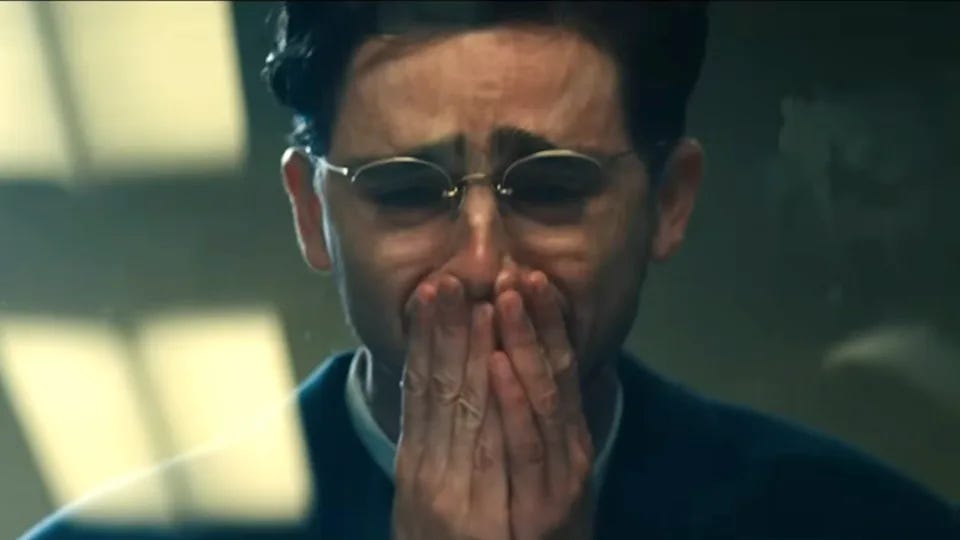
Viewers have interpreted this ending in a variety of ways. Maybe Marty is crying because he’s truly happy for the first time. Maybe he knows everything has changed, forever, and he’s mourning the end of his dream. Maybe he’s realized the insignificance and futility of everything he previously based his life on, and he’s now filled with tremendous shame for his actions. I’m sure the significance was left intentionally vague, but I know how I reacted to the ending. It made me revisit a question from my comedy days that I’d never been able to answer.
During my time pursuing a career in stand-up, I always wrestled with the concept of stability vs freedom, and whether or not a reckless disregard for convention was a necessary precursor to greatness. Or, more simply put, I kept asking myself, “Do you have to ruin your life in order to become a great artist?”
I didn’t want this to be the case. I am naturally an orderly person with a strong penchant for following the rules. If creativity required libertinism as its fuel, I was screwed.
I always maintained a day job when I was a comedian. I didn’t stay out late and abuse drugs or alcohol. I was (and remain) a relatively calm and even-keeled person. Basically, I didn’t exhibit any of the markers of the personality disorders that are so often attributed to mad geniuses. But I couldn’t shake the feeling that I needed to let these parts of myself slip a little bit if I was going to have some kind of creative breakthrough and achieve what I wanted in my comedy career. I was worried my stability was holding me back.
I was never able to fully let go. It’s just not who I am. Even if loosening up to that degree did somehow allow me to write and perform better and eventually become a regular at The Comedy Cellar, I don’t think I could have handled the constant sense of instability. I like paying my rent on time too much.
My responsibilities have only multiplied since I quit stand-up. I have an eight-month-old son. I recently started a new job that, while potentially more lucrative, demands a lot more time and mental bandwidth than any of my previous roles. My wife is back at work full-time after maternity leave, so there is the additional negotiating of schedules, childcare and general household admin work that wasn’t necessary a few months ago. “We’re out of dishwasher pods. Who is going to pick some up on the way home tonight?” is now something that needs to be actively discussed hours in advance, lest we get caught with a sink full of dirty dishes and nowhere to put our used bottles.
As a result of this, my creative work has fallen by the wayside. I’ve barely written anything over these last few months. I want to write, but I’m currently lacking the time, energy and motivation.
But this is to be expected, right? It’s why artists choose the path of freedom, so that they can live unencumbered and create without impediment. As Marty tells a very pregnant Rachel during his quest to get to Japan, “I am in no position to settle down right now.”
Here’s the thing though. I refuse to accept that reality. I don’t want to shrug my shoulders and say “Well, that’s just how it is.” That feels like true surrender. It’s disempowering.
So, what is to be done? Or, more importantly, can anything be done in the first place? Is it even possible to fully attend to the requirements of day-to-day life while still engaging in a passion project? Maybe people lean on the myth of the tortured/chaotic artist because it’s true. Perhaps you can’t achieve greatness and be a normal person at the same time. Think about the Oracle at Delphi. The link between madness and divine inspiration goes back thousands of years. It’s Lindy.
Or maybe, just maybe, people lean on that myth because it’s convenient. It looks like sacrifice but in reality it’s nothing but indulgence. It’s easy to throw caution to the wind and think about only yourself while pursuing a dream. Any asshole without a functioning conscience could do that. What if the real challenge is committing yourself across multiple domains, each with the same degree of intensity?
As I approach 40, I have a very clear vision of what I want my life to look like. Gone are the high flying dreams of my twenties and early thirties. What I want is more grounded, but sometimes, it feels more difficult to achieve.
I want to be a present and loving father and husband. I want to achieve my objectives at work and be financially rewarded for them. I want to feel healthy and be physically fit. And I want to have a regular creative practice where I share ideas that are important to me, and have those ideas resonate with others. I don’t need to make a cent off of my creativity. I just want to do it, and have it deliver some small kind of impact.
None of these aspirations are outlandish on their own. It’s the combination of them that’s the difficult part. Going from “Either/Or” to “And” with a handful of smaller goals feels harder than going all in on one major goal. It’s not as romantic or glamorous as the idea of giving everything up for a creative dream, but it’s also not as safe or boring as one might think. Discipline combined with purpose and anchored in a sense of morality might be its own form of madness. What’s crazier than thinking you can have it all?
I never made it as a comedian. I doubted my skill level plenty of times, but I never once doubted my drive or my work ethic. I threw everything I had into it, and then some. That drive still exists in me, begging to be put to good use. I want to re-activate it and channel it towards more holistic ends. What I’ve always admired about characters like Marty Mauser (Or Andrew in Whiplash or Borden in The Prestige or Mozart in Amadeus) is the unending well of vitality they drew from as they pursued what was meaningful to them. I’ve done this in the past focused on being great at one thing, but maybe now I can re-allocate that same energy, this time with the intention of being very good at multiple things.
I cut a lot of nonsense out of my life during Lent this year and I feel a greater sense of clarity than I have in a long time. This feels like the perfect moment to rededicate myself to what I want my life to look like, while shifting my perspective on what I think my ceiling is. The first step is believing that family, work and creativity don’t exist in opposition to each other, but instead are different pieces of the same whole. They can reinforce rather than compete.
I might be wrong about this, but I’ll get much closer to where I want to be trying and failing than never trying at all.
Update about a month and a half out from this post: It's not going well!
Time isn't really my biggest obstacle when it comes to writing. I can brute force any schedule I need to within a reasonable window. The real issue is energy and inspiration. When I sit down to write, I can't think of anything interesting that I want to say. My other obligations eat up a lot of mental bandwidth, and writing gets the meager leftovers.
At this point, I think I need to sit back and wait until I'm struck with an idea that I'm strongly compelled to get out, that I NEED to write about or it feels like my skin is crawling with bugs. I haven't felt that way in a few months, but I'm sure it will return at some point. Until then...
So, basically, you're saying you hated the ending to "La La Land"? 😆 Seriously, though, another great read, Peter. That balance is certainly hard, as I've had to learn with one kid turning into three, but it's not impossible.